
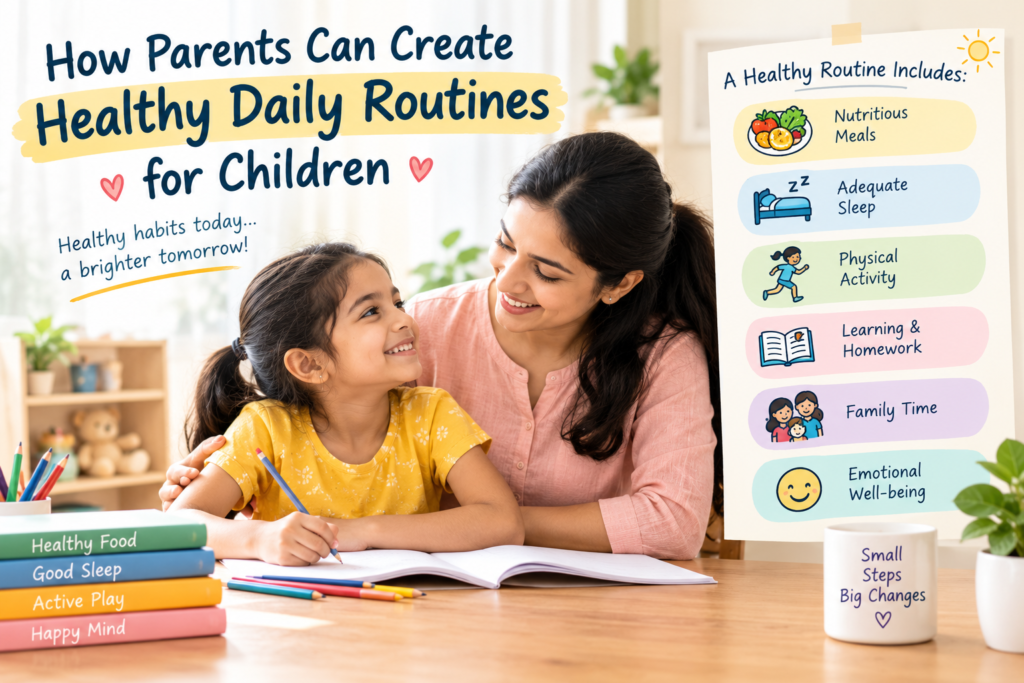
Children thrive when they know what to expect. A predictable daily routine can help children understand when it is time to wake up, eat, learn, play, relax, and sleep. While every family has different schedules, creating a few consistent habits can make everyday life more organized and comfortable for both children and parents.
A healthy routine is not about filling every minute of a child’s day with activities. Children also need free time, play, rest, creativity, family interaction, and opportunities to make age-appropriate choices.
The goal is to create a routine that supports a child’s physical health, emotional well-being, learning, independence, and family relationships.
In this article, we explore practical ways parents can build healthy daily routines for children without making family life feel overly strict or stressful.
Why Are Daily Routines Important for Children?
Children are constantly learning about the world around them. A regular routine gives them a sense of structure and helps them understand what happens next.
For example, when a child knows that breakfast comes after getting dressed and school comes after breakfast, the morning can become easier to manage.
A consistent routine may help children:
- Understand expectations
- Develop independence
- Build healthy habits
- Prepare for school and learning
- Get adequate rest
- Make time for physical activity
- Develop responsibility
- Feel more secure about daily activities
Routines can be particularly helpful during transitions, such as starting school, moving to a new class, welcoming a new sibling, or adjusting to changes at home.
However, routines should remain flexible. Unexpected events are part of family life, and children need to learn how to adapt as well.
1. Start With a Consistent Wake-Up Time
A child’s morning often sets the tone for the rest of the day.
Try to maintain a reasonably consistent wake-up time, especially on school days. Children may find it easier to follow a routine when mornings happen in roughly the same order.
A simple morning sequence might be:
Wake up → Use the bathroom → Brush teeth → Get dressed → Eat breakfast → Pack the school bag → Leave for school
You can create a visual chart for younger children using pictures or simple words.
Instead of repeatedly giving instructions, parents can point to the chart and encourage the child to follow the next step.
This gradually helps children become more independent.
2. Make Breakfast Part of the Morning Routine
Breakfast is an opportunity to introduce nutritious foods into a child’s day.
A balanced breakfast can include foods from different food groups, depending on the child’s dietary needs and family preferences.
Examples include:
- Idli with sambar
- Vegetable dosa
- Oats with fruit
- Eggs with whole-grain toast
- Poha with vegetables
- Yogurt with fruit and nuts, when age-appropriate
Children’s nutritional requirements change with age. Younger children may also have specific food safety considerations, so parents should choose foods appropriate for the child’s developmental stage.
Try to make breakfast a calm family moment rather than a rushed activity whenever possible.
3. Encourage Good Hygiene Habits
Daily hygiene habits should become part of a child’s routine from an early age.
Children can gradually learn to:
- Brush their teeth
- Wash their hands
- Bathe regularly
- Keep their nails clean
- Cover their mouth when coughing or sneezing
- Change into clean clothes
- Keep personal belongings organized
Rather than simply telling children what to do, explain why the habit matters.
For example, teach them that washing their hands helps remove germs and can reduce the spread of infections.
Younger children may need supervision and assistance, while older children can gradually take greater responsibility.

4. Create a Healthy School Routine
School introduces children to learning, social interaction, responsibilities, and new experiences.
Parents can support this process by establishing a routine around school preparation.
The night before school, children can help:
- Pack their school bag
- Prepare their uniform
- Keep shoes ready
- Organize books
- Fill their water bottle
- Prepare any required materials
This reduces morning stress and teaches children that preparation is part of responsibility.
Give children age-appropriate tasks rather than doing everything for them.
5. Set Aside Time for Homework and Learning
After school, children need time to relax before immediately starting another demanding activity.
Depending on the child’s age and schedule, create a regular period for homework or reading.
A comfortable study environment should ideally have:
- Adequate lighting
- Minimal distractions
- Necessary school supplies
- A suitable chair and table
- A reasonable noise level
Avoid expecting children to study continuously for long periods without breaks.
Younger children generally need more frequent opportunities to move and play.
Parents can encourage learning without turning every moment into a lesson.
Reading a story together, discussing a school topic, cooking together, visiting a library, or exploring nature can also support learning.
6. Make Physical Activity a Daily Habit
Children naturally need opportunities to move, play, and explore.
Physical activity can include structured sports as well as ordinary play.
Depending on age and ability, children can enjoy:
- Running
- Cycling
- Swimming
- Dancing
- Playing football or cricket
- Jumping
- Outdoor games
- Walking
- Playground activities
Not every child enjoys competitive sports, and that’s completely fine.
The goal is to help children develop a positive relationship with movement rather than making exercise feel like punishment.
Whenever possible, parents can participate too. A family walk, bicycle ride, or game can become quality family time.
7. Give Children Enough Free Play
A healthy routine should not be packed with school, tuition, sports, classes, homework, and other activities from morning until night.
Children need unstructured time.
Free play allows children to use their imagination, make decisions, experiment, and develop creativity.
They might:
- Draw
- Build with blocks
- Play pretend games
- Read
- Play with toys
- Explore outdoors
- Create crafts
- Play with siblings
Parents don’t need to direct every activity.
Sometimes the best thing a parent can do is give a child safe space to decide what to do.

8. Create Healthy Screen-Time Habits
Digital devices are now part of children’s lives. Phones, tablets, computers, gaming systems, and television can provide education and entertainment.
The challenge is finding a healthy balance.
Instead of focusing only on a strict number of minutes, parents should consider what the child is doing on the screen, when they are using it, and what activities it is replacing.
Try creating screen-free times such as:
- During family meals
- Before bedtime
- During homework
- During family conversations
Keep devices away from the child’s sleeping area when practical.
Parents can also model healthy technology habits. Children are more likely to follow screen rules when adults follow reasonable boundaries themselves.
9. Teach Children About Healthy Food Choices
Children learn eating habits from their environment.
Rather than labeling foods as completely “good” or “bad,” teach children about variety and balance.
Encourage them to try:
- Different fruits
- Vegetables
- Whole grains
- Pulses
- Dairy or suitable alternatives
- Eggs, fish, meat, or plant-based protein depending on family preferences
Involve children in age-appropriate food preparation.
For example, a child might wash vegetables, arrange fruit on a plate, or help choose vegetables for dinner.
Avoid using food as a reward or punishment whenever possible.
Creating a positive relationship with food is more important than forcing children to finish every item on their plate.
10. Make Family Meals a Routine
Family meals provide more than nutrition.
They can create opportunities for communication and connection.
Try having meals together when schedules allow.
During meals, parents can ask simple questions:
“What was the best part of your day?”
“Did anything interesting happen at school?”
“What would you like to do this weekend?”
These conversations can help parents understand what is happening in their child’s life.
Don’t worry if family meals are not possible every day. Even a few shared meals each week can create meaningful family time.
11. Teach Children to Manage Their Responsibilities
A routine is also an opportunity to develop independence.
Children can gradually take responsibility for tasks appropriate to their age.
Younger children might:
- Put toys away
- Place clothes in a laundry basket
- Put books on a shelf
Older children might:
- Organize their school bag
- Prepare simple items for school
- Keep their room organized
- Help with household tasks
- Manage homework deadlines
The objective is not perfection.
Allowing children to make small mistakes while learning responsibility can be valuable.
12. Build a Calm Evening Routine
Evenings can become chaotic if children move directly from homework, games, or screens into bedtime.
A predictable evening routine can make the transition easier.
For example:
Dinner → Family time → Prepare school items → Bath → Brush teeth → Reading → Bed
The exact routine will depend on the child’s age and family schedule.
The important part is creating a pattern that signals that the day is coming to an end.
13. Protect Children’s Sleep
Sleep plays an important role in childhood development and daily functioning.
Children generally need more sleep than adults, and the amount varies according to age.
A consistent bedtime and wake-up routine can help children develop healthy sleep habits.
Parents can create a sleep-friendly environment by:
- Keeping the bedroom comfortable
- Reducing stimulating activities before bed
- Limiting screens close to bedtime
- Following a predictable bedtime routine
- Keeping bedtime reasonably consistent
If a child regularly has difficulty sleeping, snores heavily, experiences unusual breathing during sleep, or is excessively sleepy during the day, parents should discuss the concern with a healthcare professional.
14. Teach Children About Emotions
A healthy routine should include emotional well-being, not just food, exercise, and sleep.
Children experience frustration, disappointment, fear, excitement, jealousy, sadness, and anger.
Parents can help by teaching children that emotions are normal while also teaching appropriate ways to express them.
Instead of saying:
“Don’t be angry.”
try:
“I can see that you’re angry. Tell me what happened.”
Help children identify emotions with simple words.
You can also teach age-appropriate coping strategies such as taking a break, talking to someone, drawing, breathing slowly, or asking for help.
15. Create Time for Family Connection
Children need attention and connection from the people who care for them.
Family connection doesn’t have to involve expensive outings.
You can:
- Have dinner together
- Read a story
- Take an evening walk
- Play a board game
- Cook together
- Talk before bedtime
- Visit relatives
- Spend time outdoors
Even ten or fifteen minutes of focused attention can be meaningful when the parent is fully present.
Put away the phone and listen when your child wants to talk.
16. Avoid Making the Routine Too Strict
A routine should provide structure, not pressure.
There will be days when:
- The child wakes up late
- Homework takes longer
- A family event changes the schedule
- The child becomes sick
- A school activity runs late
- Travel disrupts normal habits
Don’t treat these situations as failures.
Teach children that routines are useful guidelines, but flexibility is also important.
A healthy family routine should be able to adapt.
17. Be a Role Model
Children learn more from what adults do than what adults say.
If parents want children to eat nutritious foods, parents can demonstrate balanced eating.
If parents want children to spend less time on phones, adults can also create phone-free periods.
If parents want children to manage stress calmly, they can demonstrate healthy ways of dealing with difficult situations.
Parents don’t need to be perfect.
Showing children how to make healthy choices, apologize after mistakes, and try again can teach powerful life lessons.
Sample Daily Routine for a School-Age Child
Every family will have different schedules, but the following example shows how different activities can fit into a day:
6:30 AM – Wake up and personal hygiene
7:00 AM – Breakfast
7:30 AM – Prepare for school
8:00 AM – School
3:30 PM – Return home and have a nutritious snack
4:00 PM – Relax and free play
5:00 PM – Outdoor activity or sport
6:00 PM – Homework/reading
7:30 PM – Dinner and family conversation
8:00 PM – Prepare school items and bedtime routine
8:30 PM – Reading or quiet activity
9:00 PM – Bedtime
This is only an example. Children’s sleep requirements, school timings, age, activities, and family circumstances differ.
How to Make a Routine Actually Work
Creating a routine is easier than maintaining one.
Here are some practical tips:
Start Small
Don’t introduce ten new rules in one day.
Start with one or two habits, such as a consistent bedtime or morning preparation.
Use Visual Reminders
Pictures, charts, checklists, and colorful schedules can help younger children understand routines.
Give Choices
Instead of saying:
“Get ready now.”
try:
“Would you like to brush your teeth before getting dressed or after?”
Giving limited choices can help children feel involved.
Praise Effort
Notice when your child follows the routine independently.
You might say:
“You packed your school bag without me reminding you. That’s great responsibility.”
Specific praise is often more useful than simply saying “good job.”
Be Patient
Children won’t follow a routine perfectly every day.
Consistency develops gradually.
When Should Parents Seek Professional Guidance?
Every child develops differently. Parents should not compare their child with every other child of the same age.
If you have concerns about your child’s growth, eating, sleep, behavior, learning, emotional well-being, or development, speak with a qualified pediatrician or other appropriate healthcare professional.
Professional guidance can help parents understand whether a concern is part of normal development or needs further evaluation.
Final Thoughts
Creating a healthy daily routine for children is not about creating a perfect timetable.
It is about building a supportive environment where children have regular opportunities to eat well, sleep adequately, move their bodies, learn, play, connect with family, express emotions, and gradually become independent.
Start with simple habits. Keep expectations realistic. Allow children to participate in creating the routine. Be flexible when life changes the schedule, and remember that parents are learning too.
A healthy routine is built one small habit at a time.
When children have structure, support, and room to grow, everyday routines can become valuable foundations for a healthier and more confident future.
Disclaimer
This article is intended for general educational purposes and does not replace personalized medical or pediatric advice. Children’s nutritional, developmental, sleep, and healthcare needs vary according to age and individual circumstances. If you have concerns about your child’s health or development, consult a qualified healthcare professional.