
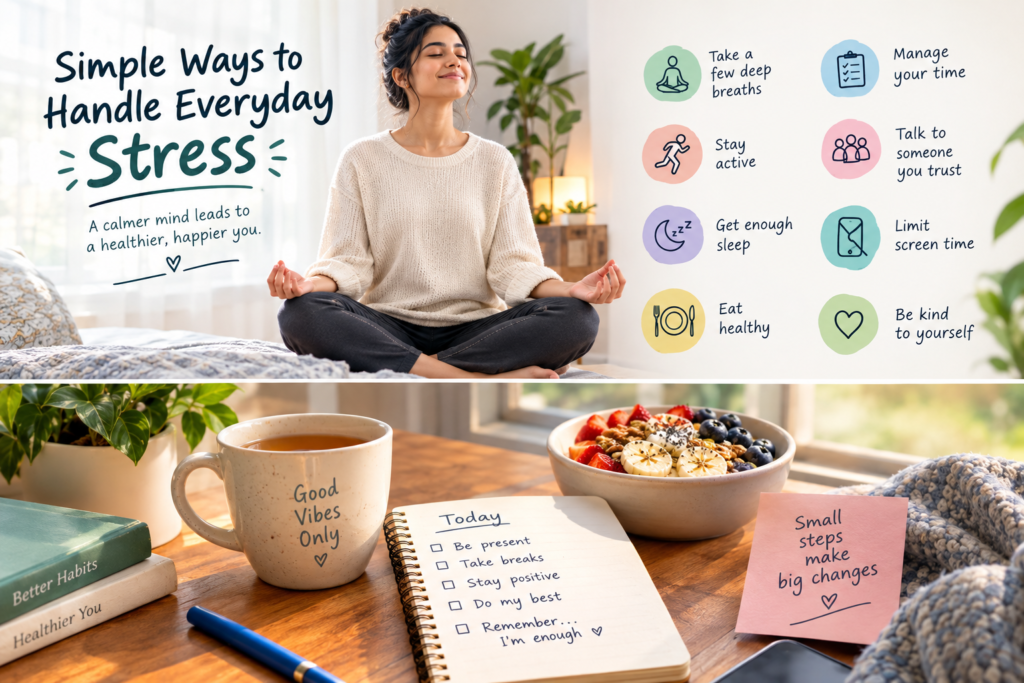
Stress has become a common part of modern life. A busy work schedule, academic pressure, family responsibilities, financial concerns, relationship problems, social expectations, and constant notifications can leave the mind feeling overwhelmed. While some stress is a normal response to challenging situations, too much stress over a long period can affect how we think, feel, behave, and function each day.
The good news is that managing everyday stress does not always require major lifestyle changes. Small, consistent habits can help create more balance and give your mind regular opportunities to relax and recover.
In this article, we explore simple and practical ways to handle everyday stress, from organizing your day and improving sleep to taking breaks, staying physically active, and building supportive relationships.
What Is Everyday Stress?
Stress is the body’s natural response to situations that feel demanding, uncertain, or challenging. When you face a stressful situation, your body may become more alert and ready to respond.
For example, you might notice:
- A faster heartbeat
- Muscle tension
- Increased alertness
- Restlessness
- Difficulty concentrating
- Changes in appetite
- Irritability
- Trouble relaxing
Short periods of stress can sometimes motivate us to complete an important task or respond quickly to a problem.
The concern arises when stress becomes frequent, overwhelming, or difficult to manage.
How Can Everyday Stress Affect You?
Everyone responds to stress differently. A stressful period may affect your mood one day and your sleep or concentration another day.
Ongoing stress may be associated with:
- Feeling constantly tired
- Difficulty concentrating
- Irritability or mood changes
- Headaches or muscle tension
- Changes in sleeping patterns
- Changes in eating habits
- Reduced motivation
- Feeling overwhelmed by ordinary responsibilities
These experiences can also have many other causes, so persistent or concerning symptoms should not automatically be attributed to stress.
Learning to recognize your own stress signals is an important first step.
1. Start Your Day Without Immediately Checking Your Phone
Many people begin their morning by checking messages, social media, emails, or news.
Before the day has even started, the brain can suddenly be exposed to dozens of demands and distractions.
Instead, try giving yourself a few quiet minutes after waking up.
You could:
- Drink some water
- Open the curtains
- Stretch gently
- Take a few slow breaths
- Think about your priorities for the day
- Have breakfast without your phone
You don’t have to completely avoid your phone. The goal is simply to avoid allowing notifications to control the first few minutes of your day.
2. Make a Realistic To-Do List
A long list of unfinished tasks can make the day feel overwhelming.
Instead of writing down everything you could possibly do, identify the most important tasks.
Try dividing your list into three groups:
Must do: Important tasks that need attention today.
Should do: Tasks that are useful but can wait if necessary.
Could do: Tasks that would be nice to complete but aren’t urgent.
This approach helps you focus on priorities instead of constantly thinking about everything at once.
Remember that a productive day does not mean completing every task on your list.
3. Break Large Tasks Into Smaller Steps
Large responsibilities often feel stressful because they appear difficult to finish.
For example, instead of writing:
“Complete project.”
Break it into:
- Collect information.
- Create an outline.
- Complete the first section.
- Review the work.
- Make corrections.
- Finish the final version.
Smaller steps feel more manageable and make progress easier to see.
This technique can be useful for students, professionals, parents, and anyone dealing with a large responsibility.

4. Take Short Breaks During the Day
Working continuously for several hours may leave you mentally exhausted.
Short breaks give you an opportunity to step away from the task and reset your attention.
During a break, try:
- Walking around
- Stretching
- Looking away from the screen
- Drinking water
- Getting some fresh air
- Taking a few slow breaths
A break does not have to be long to be useful.
The important thing is to actually step away from the task rather than replacing work with another demanding activity.
5. Try Simple Breathing Exercises
When people are stressed, they may breathe more quickly or hold tension in their body without realizing it.
Slow, comfortable breathing can be a simple relaxation technique.
Sit comfortably and pay attention to your breathing. Take a gentle breath in and allow the breath out slowly. Continue for a few minutes without forcing your breathing.
You can practise this at your desk, before an important meeting, while waiting for an appointment, or before going to bed.
If breathing exercises make you uncomfortable or dizzy, stop and return to normal breathing.
6. Move Your Body Regularly
Physical activity is not only about fitness. Regular movement can also be an important part of a balanced lifestyle.
You don’t need an expensive gym membership or a complicated workout routine.
Consider activities such as:
- Walking
- Cycling
- Dancing
- Swimming
- Yoga
- Stretching
- Playing a sport
- Light strength exercises
Choose something you enjoy.
Even a short walk after work or during a break can help you step away from stressful thoughts and reconnect with your surroundings.
If you have a medical condition or have not exercised for a long time, consider getting appropriate professional advice before starting strenuous exercise.
7. Protect Your Sleep
Stress and sleep can influence each other. When you are stressed, falling asleep may become difficult. Poor sleep can then make the following day feel more challenging.
Create a consistent sleep routine whenever possible.
Helpful habits may include:
- Going to bed and waking up at similar times
- Reducing screen use before bed
- Keeping the bedroom comfortable
- Avoiding large meals immediately before sleeping
- Limiting caffeine later in the day
- Creating a relaxing bedtime routine
You don’t need a perfect routine. Small improvements can make your evenings calmer.
If sleep problems continue for a long time or significantly affect your daily life, speak with a healthcare professional.
8. Eat Regular, Balanced Meals
When life gets busy, eating habits can easily become irregular.
Some people skip meals and later feel extremely hungry, while others rely heavily on packaged snacks or sugary drinks.
Try to maintain regular meals that include a variety of foods.
A balanced eating pattern can include:
- Vegetables
- Fruits
- Whole grains
- Pulses and beans
- Protein-rich foods
- Nuts and seeds
- Dairy or suitable alternatives
- Adequate fluids
There is no single diet that works for everyone. Your nutritional needs depend on factors such as age, activity level, health status, and personal preferences.
9. Reduce Unnecessary Digital Noise
Technology makes life easier, but constant notifications can make it difficult to mentally switch off.
Consider turning off non-essential notifications.
You could also create specific times to check:
- Social media
- Personal messages
- Emails
- News
- Shopping applications
Instead of checking your phone every few minutes, decide when you actually need to check it.
This simple boundary can create more uninterrupted time during the day.
10. Spend Time Outdoors
Spending time outside can provide a useful break from work, screens, and indoor environments.
You might:
- Take a morning walk
- Sit in a park
- Spend time gardening
- Walk with a friend
- Eat a meal outdoors
- Simply spend a few minutes observing your surroundings
You don’t need to turn outdoor time into another task on your schedule.
Even a short change of environment can help break up a stressful day.

11. Talk to Someone You Trust
Stress can feel heavier when you keep everything to yourself.
Talking with someone you trust can provide emotional support and a different perspective.
It could be:
- A family member
- A close friend
- A teacher
- A colleague
- A mentor
- A counselor
You don’t always need someone to solve your problem. Sometimes being able to express what you’re experiencing is helpful in itself.
Healthy relationships are an important part of emotional well-being.
12. Learn to Say “No”
Many people experience stress because they try to meet everyone’s expectations.
You may already have enough responsibilities, yet still agree to additional tasks because you don’t want to disappoint someone.
Learning to say no respectfully is not selfish.
You can say:
“I would like to help, but I don’t have enough time right now.”
or
“I won’t be able to take this on at the moment.”
Setting reasonable boundaries can protect your time and energy.
You don’t have to explain every decision in detail.
13. Avoid Trying to Control Everything
Some situations are within your control, while others are not.
You can control:
- How you prepare
- How you communicate
- How you spend your time
- How you respond to a situation
- Whether you ask for help
But you cannot always control:
- Other people’s opinions
- Unexpected events
- The past
- Every outcome
- Other people’s decisions
When you notice yourself worrying about something you cannot change, redirect your attention toward the part you can influence.
This can make difficult situations feel more manageable.
14. Make Time for Activities You Enjoy
Life can become focused entirely on work and responsibilities.
When every hour is dedicated to productivity, there may be very little time for activities that make you feel refreshed.
Make space for things you genuinely enjoy.
For example:
- Listening to music
- Reading
- Painting
- Cooking
- Gardening
- Singing
- Watching a favorite movie
- Spending time with family
- Playing with a pet
- Practising a hobby
Leisure is not wasted time.
Rest and enjoyable activities can be an important part of maintaining balance.
15. Practise Mindfulness
Mindfulness means paying attention to the present moment rather than constantly being caught up in the past or worrying about the future.
You can practise mindfulness during ordinary activities.
For example, while drinking tea, pay attention to its warmth, smell, taste, and texture rather than scrolling through your phone at the same time.
While walking, notice your surroundings, your footsteps, and your breathing.
These small moments can help you become more aware of what is happening right now.
16. Stop Comparing Your Life With Others
Social media can make comparison particularly easy.
You may see someone’s career achievement, vacation, relationship, home, appearance, or lifestyle and compare it with your own life.
Remember that social media usually shows selected moments rather than the complete reality of someone’s life.
Instead of asking:
“Why am I not where they are?”
try asking:
“What progress have I made compared with where I started?”
Personal progress does not have to look the same as someone else’s.
17. Keep Your Living Space Organized
A cluttered environment can sometimes make an already stressful day feel more chaotic.
You don’t need to completely reorganize your home.
Start with one small area:
- Your desk
- Your bedroom
- Your bag
- Your kitchen counter
- Your workspace
Spend ten minutes putting things back where they belong.
A more organized environment can make everyday tasks feel easier.
18. Give Yourself Permission to Rest
One common mistake is believing that rest must be earned.
People sometimes feel guilty when they sit down, take a break, or spend time doing nothing productive.
But humans are not machines.
Rest is necessary.
If you constantly push yourself without giving your body and mind time to recover, exhaustion can build up.
Schedule breaks just as you schedule responsibilities.
19. Be Kind to Yourself
The way you talk to yourself can influence how you handle difficult situations.
Instead of saying:
“I always fail.”
try:
“This didn’t go as planned. What can I learn from it?”
Instead of:
“I should be able to handle everything.”
try:
“I’m dealing with a lot right now, and it’s okay to ask for support.”
Self-compassion does not mean ignoring mistakes.
It means responding to yourself with the same understanding you might offer someone you care about.
A Simple Daily Stress-Management Routine
You don’t need to follow every suggestion in this article.
A simple routine could look like this:
Morning:
Spend a few quiet minutes before checking your phone. Eat a balanced breakfast and identify your main priorities.
During work or study:
Take short breaks, drink enough water, and avoid unnecessary notifications.
Afternoon:
Move your body for a few minutes or take a short walk if possible.
Evening:
Spend time with family or friends, enjoy a hobby, or take some time outdoors.
Before bed:
Reduce screen use, write down tomorrow’s important tasks, and create a calm bedtime routine.
Small habits repeated regularly can be more sustainable than dramatic changes that last only a few days.
When Should You Seek Professional Help?
Everyday stress is common, but you should not feel that you have to manage overwhelming stress alone.
Consider speaking with a qualified healthcare professional or mental health professional if stress:
- Feels overwhelming or uncontrollable
- Continues for a prolonged period
- Significantly affects your sleep
- Makes it difficult to work or study
- Interferes with relationships or daily activities
- Causes persistent feelings of sadness, fear, or hopelessness
- Leads you to rely on alcohol or other substances to cope
If you ever feel that you may hurt yourself or that you are in immediate danger, seek emergency help or contact an appropriate crisis or emergency service in your area immediately.
Seeking professional support is not a sign of weakness. It is a responsible step toward taking care of yourself.
Final Thoughts
Stress is a normal part of life, but it does not have to control your entire day.
You can begin with small changes: take regular breaks, move your body, protect your sleep, organize your priorities, reduce digital distractions, spend time with people you trust, and make room for activities that genuinely make you happy.
Most importantly, don’t expect yourself to handle everything perfectly.
Some days will be productive. Other days may feel difficult. What matters is learning how to recognize when you need to slow down, reset, and seek support when necessary.
A healthier relationship with stress begins with small, consistent steps. Take care of your mind, give yourself time to rest, and remember that asking for help is always an option.